
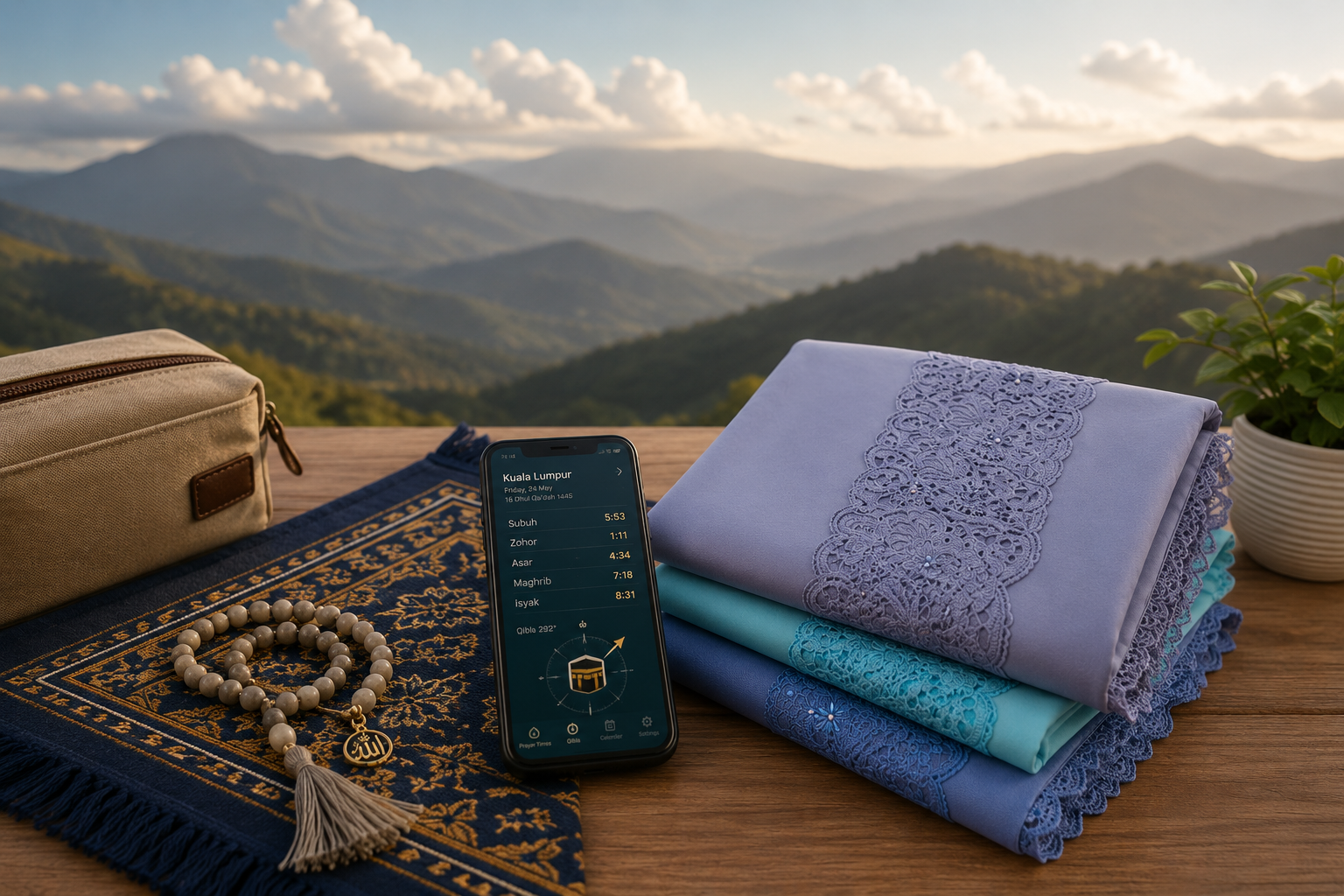
The first time we traveled somewhere with a different time zone, my kids assumed Subuh would be at the same time it always is at home. It wasn’t even close. Sunrise came earlier, Maghrib came later, and our usual rhythm was suddenly off by almost an hour in both directions.
We sat them down before the trip even really started. Prayer times aren’t the same everywhere, we told them. They change depending on where you are in the world, and that means you can’t just go on autopilot. You have to actually check, every single time, especially for Subuh, because that’s the one that slips past you fastest when you’re in a new place and still half asleep.
That one conversation ended up teaching them more than I expected. Not just the mechanics of prayer times, but something underneath it: that faith isn’t something that runs on autopilot. It asks you to stay alert, wherever you are.
That’s the part about traveling as a Muslim family that doesn’t show up in the packing lists or the “top destinations” posts. The logistics matter, sure. But what our kids are actually absorbing on these trips runs a lot deeper than logistics.
Faith Doesn’t Pause Because You’re Somewhere New
A lot of people assume travel and religious practice pull in opposite directions, like you have to choose between seeing the world and staying consistent in your deen. We’ve found the opposite to be true. Travel hasn’t loosened our kids’ relationship with prayer. If anything, it’s sharpened it.
When we’re home, prayer can blend into the background of a familiar routine. The adzan plays from the mosques which we can hear directly from our home – we don’t really think about it, the mosque is the same one it’s always been, the rhythm of the day is set. Travel strips that away. Suddenly the kids have to ask: where’s qibla from here? What time is Zohor in this city? Is there a prayer space nearby, or do we need to plan around it?
We’ve taught them to check the qiblah direction themselves using an app, rather than just trusting that mom and dad already know. Small thing, but it shifts something. They’re not just along for the ride on our faith. They’re starting to own a little piece of it themselves.

Showing Them That Travel Bends Around Prayer, Not the Other Way Around
One thing we’ve been intentional about since our kids were small: we plan our trips around prayer times, not the other way around. Practically, that means we usually leave the hotel early in the day and make our way back in the late afternoon or evening, timing things so we’re back to pray Zohor and Asar together as jamak. If we want to go back out and explore at night, that happens after. If the plan involves somewhere far that we are not able to go back to the hotel before nightfall, we will find mosques or location where we can pray. It goes into our itinerary.
It’s not the most spontaneous way to travel. We’re not the family chasing one more attraction before sunset if it means rushing through Asar or skipping it entirely. But that structure has become one of the most quietly powerful things our kids have picked up. They’ve learned, without us ever having to say it outright, that prayer isn’t something that gets sacrificed for the sake of a fuller itinerary. It’s something the itinerary gets built around.
That’s a hard thing to teach inside the four walls of home, where prayer is just what happens because the house is set up for it. On the road, when there’s a genuine pull toward “just one more stop,” and we still choose to head back for jamak, the lesson lands differently. They see us choose it. Repeatedly.
Why This Matters More Than People Think
It’s easy to treat faith-friendly travel as a logistics problem, just finding the mosque, locating qibla, figuring out what’s halal. Those things matter, and we write about them a lot, because they’re genuinely useful. But underneath the logistics, something bigger is happening every time we travel as a family.
Our kids are learning that their faith isn’t tied to one zip code. It travels with them. It adjusts to new prayer times, new cities, new languages, and it still holds. They’re learning that being far from home doesn’t mean being far from their deen, and that the effort it takes to stay consistent, checking the time, finding the direction, planning the day around the prayers, is just part of what it means to live this out, not an inconvenience to work around.
We didn’t wait for our kids to be “old enough” to understand any of this before we started traveling with them. We brought them along while they were small, let them be a little confused about the time difference, let them ask why Subuh felt so early, and let those questions become the lesson.
If you’re a Muslim parent on the fence about traveling with young kids, wondering if it’s too complicated, too risky to their routine, too hard to manage prayer on the road, we’d gently push back on that. It’s not always easy. But it’s teaching our kids something we couldn’t teach them sitting still at home: that their faith is portable, durable, and theirs to carry, wherever they end up.
How do prayer times change when you travel?
Prayer times shift based on your location’s sunrise and sunset, so they can be quite different from what you’re used to at home. When we travel, Subuh is often earlier, Maghrib and Isyak come later, and the gap between prayers stretches or shrinks depending on how far we’ve gone and what season it is. We always check a reliable prayer times app as soon as we land, rather than assuming our usual schedule still applies.
Can you combine prayers while traveling in Islam?
Yes. Islam allows travelers to combine Zohor with Asar, and Maghrib with Isyak, known as jamak, as a concession for the difficulty of being on the road. This is exactly how we manage our own trips. We plan our day so we’re back at the hotel in time to pray jamak, rather than trying to squeeze in two separate prayer sessions while we’re out and about.
How do you find the qibla direction in a new country?
We use a qibla compass app, the same one we use to check prayer times. Most apps will point you toward Mecca automatically based on your phone’s GPS, but it only works accurately if your location services are turned on and updated to where you actually are. We’ve made it a habit to double check this every time we land somewhere new.
Is it hard to travel as a Muslim family with young kids?
It takes more planning than a typical trip, but it’s far from impossible. The biggest adjustments are usually around prayer times, halal food, and finding modest-friendly spaces, all of which get easier with a bit of pre-trip research. We’d rather plan around these things than wait for our kids to be “old enough,” since a lot of what they learn about faith on the road can’t really be taught at home.
How do you teach kids to pray while traveling?
The most effective thing we’ve found is simply letting them see it happen. When kids watch their parents choose to head back for jamak instead of squeezing in one more stop, or check the qibla direction the moment they arrive somewhere new, it sticks far more than any explanation would. We also talk them through why prayer times are different in a new place, so it becomes something they understand instead of something that just confuses them.
Leave a Reply