
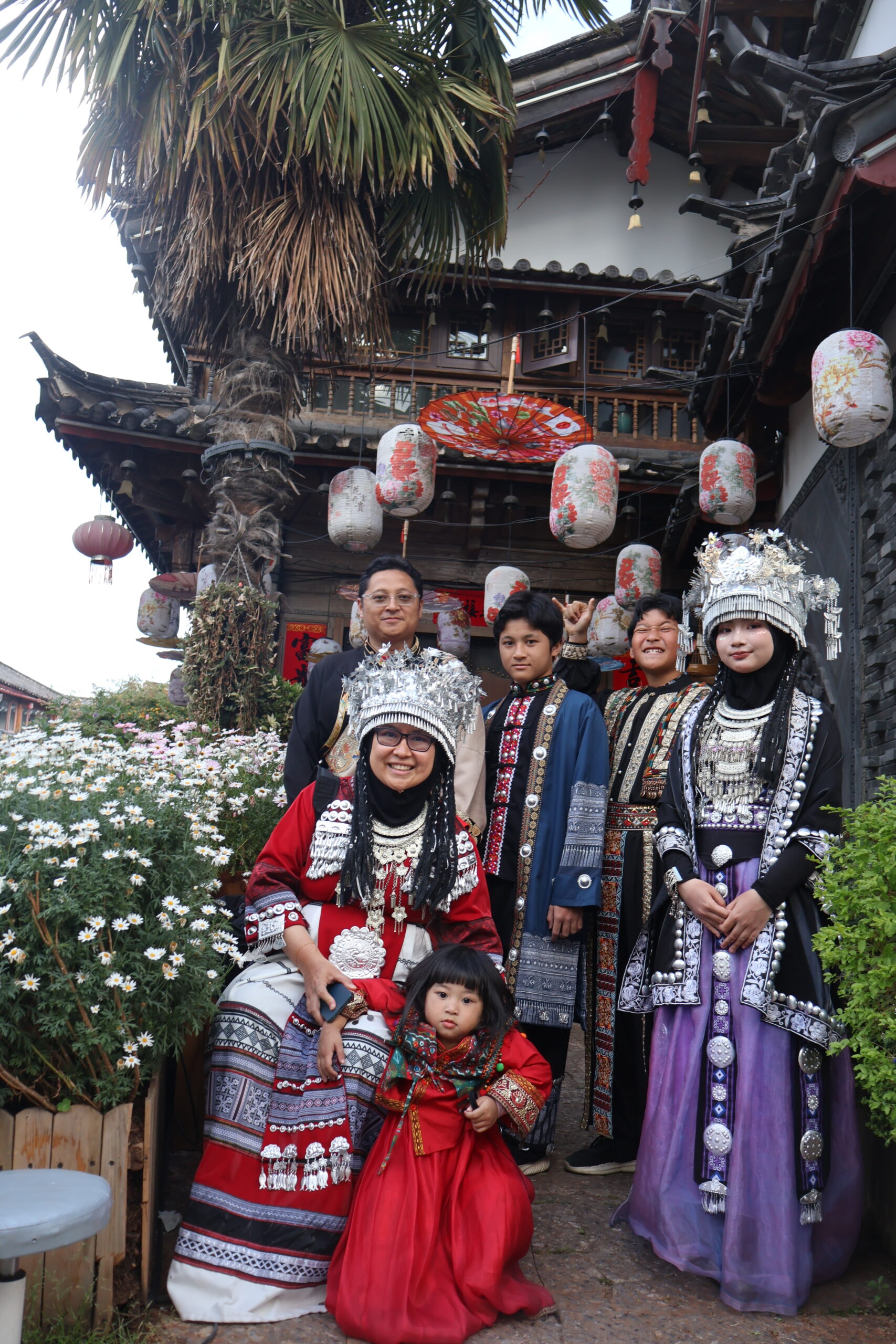
We didn’t plan for Lijiang Old Town to be the highlight of the whole trip for the kids. Honestly, we thought it would be the food, or maybe Stone Forest. But the moment we rented traditional ethnic outfits and let them walk around in it, something just clicked. Suddenly Yunnan wasn’t just “the place mom wanted to visit.” It was real to them.
That’s the thing about Yunnan that doesn’t show up in most travel guides. Everyone talks about the scenery, the food, the snow mountains. Not as many people talk about the fact that this province is home to over two dozen ethnic minority groups, each with their own dress, traditions, language, and history. For curious kids, that’s basically a living museum, except nobody’s telling them to be quiet and not touch anything.
If you’re traveling with children and wondering whether “cultural” sites will actually hold their attention, here’s what worked for us across Kunming, Dali, and Lijiang.
Dress Up in Ethnic Costume in Lijiang Old Town
This was hands down the moment our kids talk about the most.
Lijiang Old Town is home to 47 ethnic groups, and you’ll feel that diversity the second you walk past the costume rental shops lining the streets. For a small fee, you can dress the whole family up in elaborate ethnic-style outfits, think silver headdresses, layered bead necklaces, and richly embroidered panels, and just wander around in it for the afternoon.
A quick honest note here: these rental shops usually mix and match styles from across Yunnan’s many minority groups rather than sticking strictly to one. So don’t assume the outfit you’re handed is necessarily the local Naxi dress, it might draw from a totally different ethnic group’s traditional look. Ask the shop if you’re curious, some are happy to tell you, others are really just running a photo studio.

Either way, our kids loved it for the obvious reason, they got to play dress up. But it turned into more than that. They started asking questions about the silver patterns, the headpieces, why everything looked so different from anything they’d worn before. We didn’t have all the answers on the spot, but that’s exactly the point. A costume rental shouldn’t be the whole lesson, it should be the question that gets your kids curious enough to ask more once you’re home and can look things up properly.
If your children love pretend play, this is the easiest cultural entry point in all of Yunnan. No museum required, just a willingness to let your kids look a little silly in photos for an afternoon.
Good to know: rental usually comes with basic hair accessories and light makeup (extra charges if you take the basic package only), and most shops let you keep the outfit on for a few hours so you can wander the old town in it, not just take one photo and change back.
Spot the Dongba Script, the World’s Last Living Pictographic Writing
While you’re in Lijiang, keep an eye out for the Dongba script. It looks almost like tiny drawings instead of letters, little pictures of mountains, people, animals, and water, strung together to form words.
What makes this genuinely special is that Dongba is one of the only pictographic writing systems still in active use today. It’s not just a museum relic, you’ll actually see it on shop signs, street names, and souvenirs throughout Lijiang Old Town. For kids who like puzzles or who are into how language works, this is a fun thing to point out as you walk. Ours turned it into a small scavenger hunt, trying to guess what each symbol might mean before reading the translation underneath.
Wander Through Bai Culture in Dali
Dali Ancient Town belongs to the Bai people, and the architecture alone is worth slowing down for. Look up as you walk and you’ll notice white walls, blue and grey trim, and carved gates that look nothing like what you’d see in Lijiang or Kunming.
If you have a bit more time, Zhoucheng Village just outside Dali is known as a living example of Bai folk culture. This is where you can see, and sometimes try, traditional Bai tie-dye, a technique that’s been passed down for generations. Kids who enjoy anything hands-on tend to love this one, since some shops let visitors try the dyeing process themselves rather than just watching.
Another nice touch to look for is the Bai three-course tea ceremony, served in stages that go from bitter to sweet to a lingering aftertaste. It’s traditionally explained as representing life itself: hardship first, sweetness later, and reflection after. We didn’t expect our kids to sit through a tea ceremony patiently, but the storytelling behind it kept them at the table longer than we thought it would.
Let Stone Forest Spark Some Science Questions
Stone Forest, just outside Kunming, isn’t really a “cultural” site in the same way as the old towns, but it’s where culture and curiosity about the natural world meet. The karst limestone pillars rise up like a maze, and there are local Yi legends tied to several of the formations, including stories about lovers turned to stone.

For kids, this is less about sitting still and listening, and more about exploring. The pathways wind through narrow gaps and open clearings, and there’s enough space to let curious children run a little ahead while still being in sight. If your child is the type to ask “but why does it look like that,” this is a good place to let a guide or a sign answer the question instead of you.
Visit Nancheng Mosque, Where Faith and History Meet
For Muslim families, Nancheng Mosque in Kunming adds another layer to the cultural picture. It’s been the center of Islamic life in the city for almost 700 years, and walking through it gives kids a sense that Muslim history in this part of the world isn’t new or unusual, it’s deeply rooted.
Spotting the 清真 (qīngzhēn – halal) marker around the city, on restaurant windows and food stalls, is also a small but meaningful thing for kids to notice. It’s a quiet reminder that you belong here too, and for our kids, recognizing that symbol became its own little game as we walked around Kunming.
Why This Matters More Than the Photos
It would be easy to treat all of this as a checklist of photo opportunities, and honestly, the photos are lovely. But what stuck with our kids wasn’t the pictures. It was asking questions, trying something with their hands, and realizing that the world is full of people who live, dress, and believe differently than they do, and that’s not something to be cautious about. It’s something worth being curious about.
If you’re planning a Yunnan trip with kids, don’t rush past these moments to get to the next attraction on the list. Some of the best learning happened when we just let them slow down and ask “why.”
Frequently Asked Questions
Is Yunnan a good destination for teaching kids about culture?
Yes. Yunnan is home to more than two dozen ethnic minority groups, each with distinct dress, language, food, and traditions. Cities like Lijiang and Dali make this easy to experience firsthand through old towns, museums, and hands-on activities rather than just reading about it.
What age is best for cultural sightseeing in Yunnan?
Most of these experiences work well for kids aged five and up, since they involve some walking and a bit of patience. That said, younger children can still enjoy the costume rentals and Stone Forest, since both are visual and hands-on rather than lecture-style.
Are the costume rentals in Lijiang worth it for kids?
Yes, and they’re inexpensive. It’s one of the easiest ways to get children genuinely interested in local culture, since it turns an abstract idea like “tradition” into something they can wear and ask questions about. Just know the outfits on offer usually mix styles from across Yunnan’s ethnic groups rather than representing one specific local tradition, so it’s more of a fun cultural taster than an authentic recreation.
Is Stone Forest suitable for young children?
Generally yes. The main pathways are walkable for most ages, though strollers can be tricky in some narrow sections. It’s more of a natural and exploratory experience than a structured cultural site, which makes it a nice change of pace for kids after a few museum-style stops.
Do I need a guide to explain the cultural sites to kids?
Not necessarily, but it does help. A local guide can field the constant stream of “why” questions kids tend to ask, which keeps things moving instead of you trying to look up answers on the spot. That said, plenty of signage in Lijiang and Dali is bilingual, so independent exploring works fine too.
Is Nancheng Mosque open to visitors?
Yes, Nancheng Mosque welcomes visitors and has been an active center of Islamic life in Kunming for centuries. It’s a meaningful stop for Muslim families wanting to show kids that Muslim heritage in this region runs deep.
Leave a Reply